
Schuylkill Projected and Actual Release Dates
A projected date is a calculation or future expectation. An actual release date records an event that already happened. Pennsylvania records also use more precise terms: a judicial minimum date, maximum date, RRRI minimum, Board-set future parole date, BOP release date, or actual discharge date. Those labels should not be collapsed into one generic promise.
Scheduled versus actual: a minimum date allows parole consideration, and even a parole grant may depend on an approved plan, drug screening, detainer review, notices, conditions, and a release order.
A pretrial detainee at Schuylkill County Prison generally has no sentence-based release date. A bail order may create a path out, yet processing takes time and another warrant or detainer may keep the person in custody. The UJS docket explains the legal order; the prison confirms whether the person actually left and whether another authority received custody.
Find a Schuylkill County Release Date
Begin with the system responsible for the confinement. Schuylkill County contains a county prison, two state institutions, a federal prison complex, and a community corrections facility. Geography alone does not identify the right sentence record.
- Collect the full committed name, date of birth, inmate or parole number, docket number, and the facility believed to hold the person.
- For a county case, search the Pennsylvania UJS case portal and read the bail, sentencing, commitment, and later order entries.
- Call Schuylkill County Prison at 570-628-1461 for present custody information that staff may disclose. Ask for the process to obtain the existing admission or discharge event.
- For a state sentence, use the PA DOC Inmate Locator, then switch to the Department Supervised Individual Locator when parole supervision is possible.
- For a federal sentence, use the BOP Inmate Locator. Its released result and release date concern BOP custody, not the end of federal supervised release.
- Compare the custody source with the court or parole document and preserve the exact wording and lookup date.
The broader Schuylkill County released-inmate search guide explains how to distinguish a county departure, a transfer to PA DOC, release on supervision, and final discharge. Two compatible records are stronger than any no-result screen.
PA DOC Release-Date Search Limits
The public PA DOC application is a paired locator for people currently under department jurisdiction or supervision. Its search fields include first, middle, and last name; inmate or parole number; gender; committing county; current location; citizenship; and date of birth or approximate age. DOC advises trying only the last name when a full search fails, and the public application states that it is updated daily.
Research of the current interface did not verify a public field labeled “Projected Release Date,” “Tentative Release Date,” “Minimum Date,” or “Maximum Date.” It would therefore be wrong to promise that the public result supplies one. A supervised-person detail can contain a release date, office or county information, and an absconder notation where applicable, but that release date documents movement onto supervision rather than sentence completion.
The PA DOC dual locator screen shows the two populations a researcher must choose between.
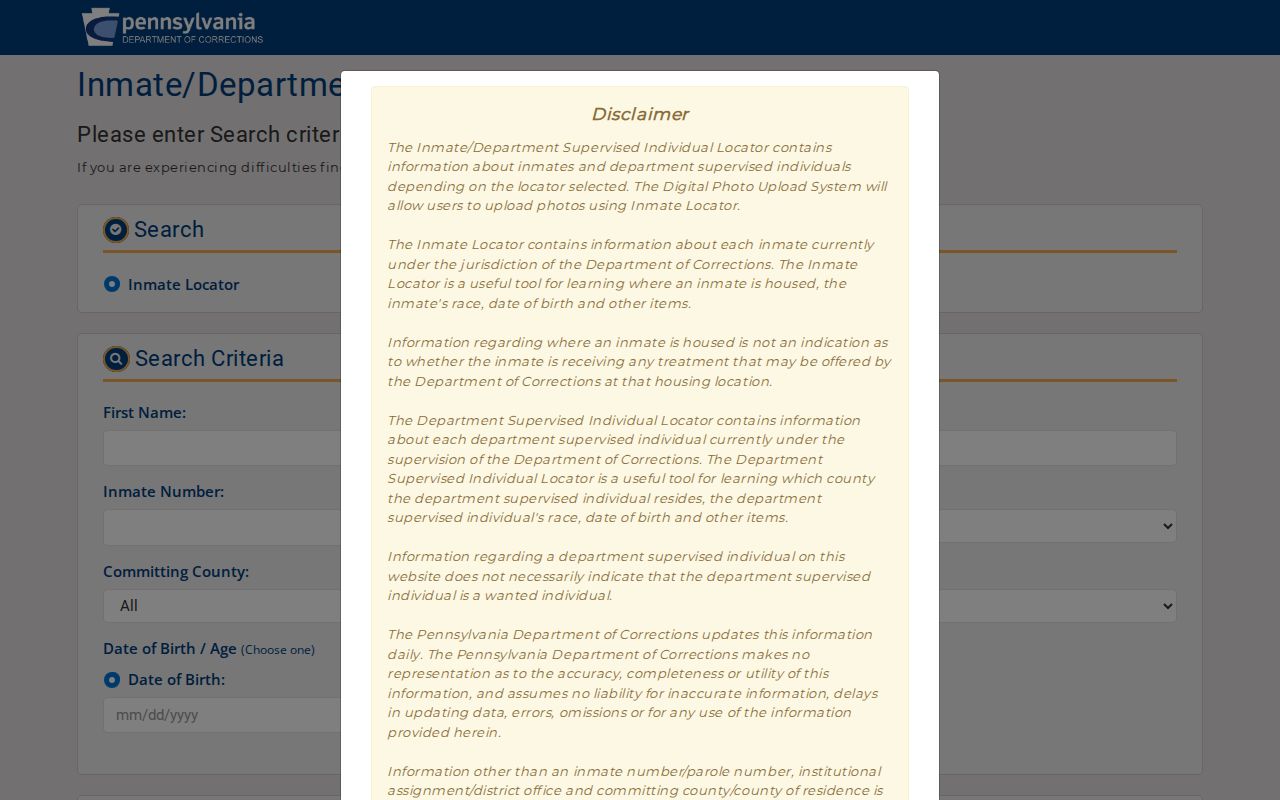
A person who reached the maximum and left supervision may disappear from both public populations. Absence can also reflect a county or federal case, an intake delay, spelling variation, or different identifiers. For a date not displayed publicly, use the sentencing order, appropriate DOC records route, and the final Pennsylvania Parole Board Action when parole is involved.
Schuylkill Minimum and Maximum Dates
Pennsylvania usually uses indeterminate state sentences. Under 42 Pa.C.S. § 9756, the court states a maximum and a minimum, with the minimum generally no more than one-half of the maximum. The minimum is the first ordinary parole-eligibility point. The maximum is the outer sentence endpoint, subject to lawful recalculation.
The Pennsylvania Parole Board process guide expressly says the minimum is not a guaranteed release date. The Board may grant or deny parole after considering the statutory case. A grant can name a later effective date. It can also be rescinded for good cause before physical release.
Date terms in Pennsylvania
Minimum date: the usual first point for parole eligibility. Maximum date: the sentence endpoint after valid calculations. Board Action: the written parole decision. Actual release: the custody event recorded when the person leaves that custodian.
County commitments require a separate reading. A county sentence, court credit order, county parole decision, and prison discharge event govern the answer. State formulas should never be placed onto a Schuylkill County Prison commitment unless the statute and commitment actually use that program.
Schuylkill Good-Time Claims Checked
Pennsylvania has no blanket rule requiring a state prisoner to serve 85 percent of the maximum before parole. That familiar shorthand belongs to a different federal framework. Ordinary Pennsylvania Board eligibility generally starts after the judicial minimum under 61 Pa.C.S. § 6137, while release remains discretionary or depends on a defined statutory route.
Nor is there a universal ordinary “good time” subtraction for every Pennsylvania state minimum. The Recidivism Risk Reduction Incentive program can create an RRRI minimum for a statutorily eligible person. Under 61 Pa.C.S. § 4505, that minimum is three-fourths of a minimum sentence of three years or less and five-sixths of a longer minimum, with statutory calculation rules. Eligibility exclusions under § 4503 and DOC certification still matter.
Short Sentence Parole under § 6137.1 can apply to qualifying DOC commitments whose aggregate minimum or RRRI minimum is two years or less, whichever is shorter. Offense exclusions, pending cases, misconduct, detainers, warrants, prior decisions, and Board findings may prevent or delay that path. Neither RRRI nor Short Sentence Parole is generic earned release.
No official Schuylkill-specific county good-time formula, weekend-release rule, or Sunday-to-Friday adjustment was found. For a county sentence, rely on the commitment, sentencing order, credit orders, county parole action, and the prison’s calculation. A borrowed practice from another county is not evidence.
What Changes a Schuylkill Release Date
A date can move for legal, factual, or administrative reasons. The source record should identify the kind of change before anyone recalculates a calendar.
| Factor | Effect on the date or release |
|---|---|
| Time-served credit | A court ruling or correction can change the sentence calculation. |
| Concurrent or consecutive terms | Aggregation changes how minimum and maximum dates relate. |
| Amended judgment or appeal | A new court order can replace the prior calculation. |
| Parole decision | A denial delays release; a grant may set a future date and conditions. |
| Violation and recommitment | Backtime and recalculation can create a new parole timeline. |
| Warrant or detainer | The person may leave one facility directly into another agency’s custody. |
| Administrative prerequisites | Planning, testing, notices, registry or DNA steps, and formal orders can delay the door-out event. |
| Data correction | DOC or the court may correct an error or add a previously missing sentence. |
A transfer is the most important reading trap. “Paroled to detainer” and movement from Schuylkill County Prison to PA DOC both end a stay at one location, but neither necessarily puts the person in the community.
Confirm a Schuylkill Physical Release
A future date should be treated as a planning marker until a custody event confirms it. For a county prisoner, pair the court order with the prison’s current-status response or discharge record. For a state prisoner, pair the final Board Action or maximum-date record with the DOC custody event and, when relevant, a supervised-individual result. For a federal prisoner, read the BOP status exactly and remember that a residential reentry center or home confinement may still be BOP custody.
PA SAVIN through VINELink can send a release, transfer, or other custody-event alert for participating Pennsylvania systems. Registration is useful before a future event, but the notice does not explain whether release resulted from bail, time served, parole, dismissal, sentence expiration, or transfer. The detailed Schuylkill VINE inmate check covers registration and its phone PIN process.
When documentary proof is necessary, request an existing record instead of asking an agency to answer a legal conclusion. A narrow county request can seek the named person’s admission and discharge event, recorded release or movement code, releasing authority, and destination agency if a transfer was recorded. Pennsylvania’s Right-to-Know Law generally gives an agency five business days for an initial response under 65 P.S. § 67.901, with a written extension available under § 902. Exempt or sensitive material may be redacted, and the law does not require creation of a new calculation.
Schuylkill Custody Dates Are System-Specific
A useful timeline labels both the date and the authority behind it. For a Schuylkill County case, record the date of the bail or sentencing order, the time the prison says custody ended, and any transfer destination. For a state case, keep the judicial minimum, maximum, Board Action date, effective parole date, and DOC release event separate. For a federal case, preserve the BOP register number, displayed release date, and location or “Released” notation. Mixing these fields can make a valid date appear to answer a question it never addressed.
FCI Schuylkill is inside the county, but a federal release date comes from BOP rather than the county prison or PA DOC. BOP records generally cover federal prisoners from 1982 forward and are updated daily. A past release date with no facility, or a “Released” location, means the person is no longer in BOP custody. It does not establish that federal supervised release has ended, and movement to a residential reentry center or home confinement can still be federal custody.
An immigration detainer introduces another boundary. The end of a county or federal prison hold can lead directly to ICE custody. ICE’s locator is useful only when the record points to immigration custody, and a not-found result can have several explanations. It should never be converted into a projected community-release date. The same caution applies to a county court order: legal authority to leave one hold does not defeat another valid commitment.
Create a simple source log when dates conflict. Note the full name and identifier searched, which portal or office supplied the date, the label displayed, the date and time checked, and whether the result concerned custody, parole eligibility, active supervision, or final discharge. Then ask the agency holding the sentence calculation to resolve the conflict. This method preserves what each source actually established and prevents a projected date from being repeated later as a confirmed release.